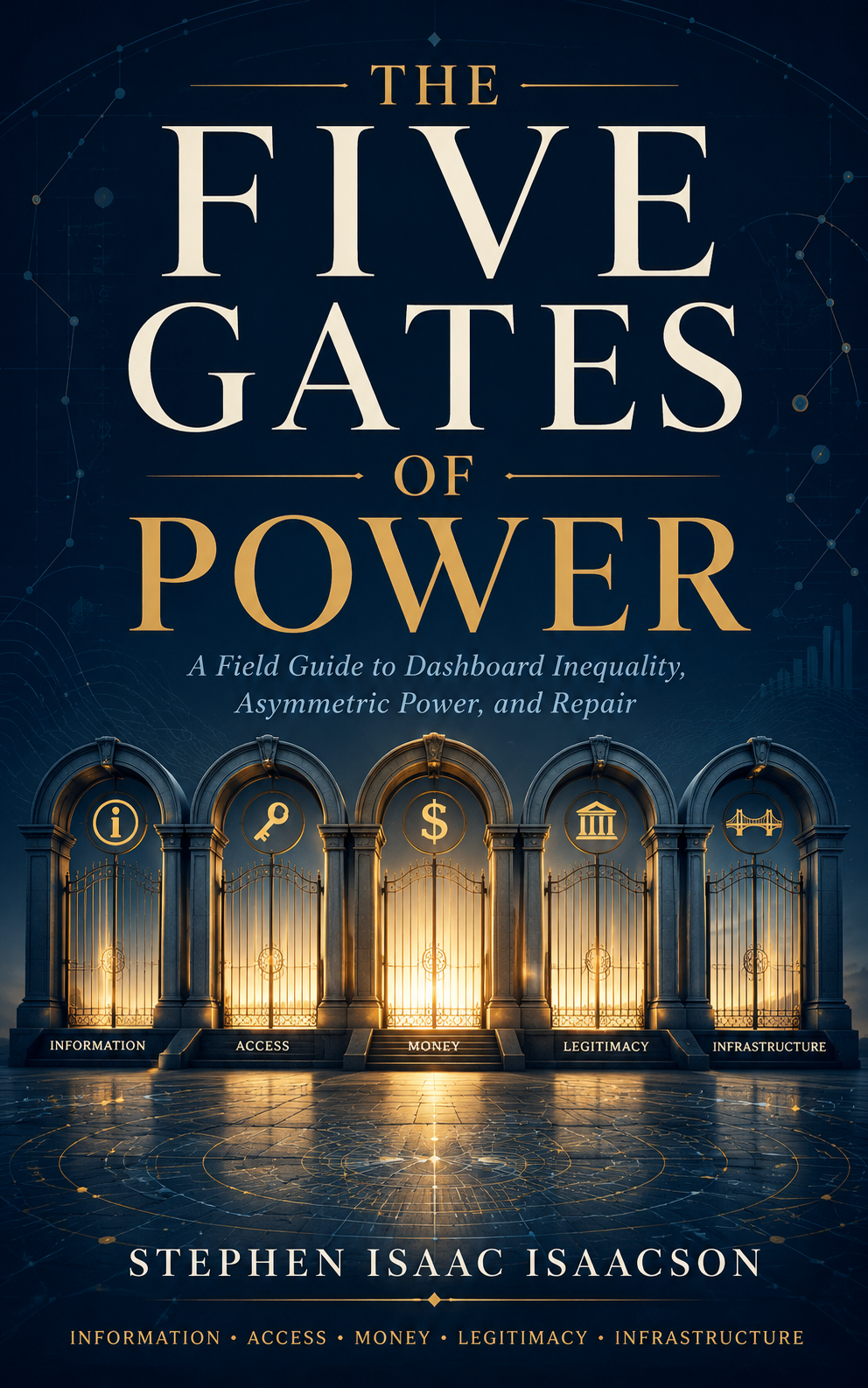
The Five Gates of Power
A Field Guide to Dashboard Inequality, Asymmetric Power, and Repair
By Stephen Isaac Isaacson
A public field guide for analysis, teaching, reflection, repair, and institutional design. It examines how information, access, money, legitimacy, and infrastructure shape who can verify reality, act on it, be believed, benefit from it, and make outcomes durable.
Power becomes harder to understand when people cannot see how decisions are made, who has access, where costs fall, whose accounts are believed, or which systems make outcomes durable. The Five Gates of Power offers a practical diagnostic map for asking those questions — not to treat every authority as illegitimate, but to make power more visible, decisions more contestable, authority more accountable, and harm more repairable.
What the field guide helps readers ask
- What was known, and who could verify it?
- Who kept access open or closed?
- What interests, costs, and risks were at stake?
- Who conferred legitimacy?
- What infrastructure shaped the outcome?
- Who enforced the rules, how strongly, and against whom?
- What changed symbolically, and what changed structurally?
- What would make repair durable?
The purpose of understanding power is not simply to expose it. It is to understand systems well enough that they can become more visible, contestable, accountable, and repairable. The strongest systems do not depend on heroic people. They make ordinary honesty easier than extraordinary integrity.
This field guide may be useful to educators and students, writers and researchers, workers and managers, community members and advocates, and readers examining institutions, media, inequality, and public life.